Heart · Kardia
The governing premise: what I trust, fear, love, and seek.
Proverbs 4:23A place to prepare for what is forming.
A Christian formation house for recovering a life governed by the Father’s love rather than fear, scarcity, and the demand to become its own source.
The House teaches the way. The Upper Room protects the private practice. The Walk is love returned to ordinary life.
there is more, unhurriedBEFORE YOU READ
Listen to this teaching.
What Is Second Humanity? — The public doorway
THE HUMAN PROBLEM · BENEATH THE REACTION
What appears in a life is carried by what the heart trusts beneath awareness.
Most personal growth focuses on managing the reaction at the surface. But we do not act from our willpower; we act from our readiness. What the heart quietly trusts or fears shapes how the mind frames an encounter. That repeated interpretation trains the nervous system what to expect. Eventually, the body’s posture becomes the outward life: our tone, our hurry, our defenses, and our silences.
The governing premise: what I trust, fear, love, and seek.
Proverbs 4:23The interpreting story: how experience is understood and repeated.
Romans 12:2Learned readiness: what the body has come to anticipate.
Psalm 131:2The outward fruit: speech, action, habit, and relationship.
Luke 6:45Second Humanity begins at the root Scripture calls the heart. “Keep thy heart with all diligence; for out of it are the issues of life.” (Proverbs 4:23) Trying to correct the visible life through willpower alone leaves the governing premise untouched—the engine keeps running beneath the floorboards. This diagnosis is not a way to blame a person for what they have learned to carry in survival. It is a way to bring the hidden allegiance into God’s light. Only as the heart receives the Father’s love does the story change, the body unlearn its defensive bracing, and a life of genuine peace become possible in the ordinary street.
THE CULTURAL CLIMATE · WHAT IS NEW
Older media—from print to television—broadcast the same message to everyone from a distance. Today’s digital landscape—the automated attention algorithms behind our feeds, notifications, and infinite scrolls—operates from within. It studies you individually, learns where you fray, and returns around the clock to capture the interval—that vital pause between receiving a stimulus and choosing how to respond.
Every pause, replay, search, tap, and departure is gathered as behavioral data. The system measures what holds your eyes—especially when you are tired.
The feed is no longer broadcast to the public; it is curated for you alone, shaped continuously by the specific fears, insecurities, and appetites you showed it minutes ago.
The world you see rearranges itself in real time. The moment your attention drifts, the feed serves whatever outrage or novelty will trigger your next reaction.
This infrastructure operates everywhere at once. It crosses bedside tables, dining rooms, workplaces, and quiet hours, synchronizing billions of people into the same state of chronic urgency.
Every click, linger, or skip instantly instructs the machine. It learns what commands your impulses long before your conscious mind decides to look.
THE EXTRACTION MACHINE
The platform does not merely show a person the world. It studies the person, discovers what reliably activates their anxiety, comparison, or appetite, and continuously reconstructs the next screen to provoke that exact reflex.
Fear, scarcity, outrage, loneliness, and the desire to be seen were not created by digital engineers—they are ancient human frailties. What is unprecedented is the machinery: automated attention algorithms measured these fractures, accelerated them, and built an economic model out of keeping them agitated.
The cascade of formation is systematically turned against us: the Heart is continually flooded with synthetic threats, curated envy, and urgent demands to secure its own worth; the Mind is fed polarizing narratives that confirm its worst suspicions; the Body is trained into chronic vigilance—shallow breath, adrenaline, and dopamine loops mistaking digital urgency for survival; and Visible Life deteriorates into compulsive checking, rapid reaction, public performance, and an existence mediated by the curated profile.
This pattern is as old as the desert. When the tempter met Jesus in the wilderness, the pressure targeted these exact fault lines: physical appetite, the demand to stage a public spectacle, and the promise of immediate worldly influence without the slow work of love. The ancient adversary tried to force a panicked reaction out of isolation. Today’s platform does the same—only now it operates around the clock, in your pocket, at planetary scale.
“Then was Jesus led up of the Spirit into the wilderness to be tempted of the devil.”Matthew 4:1, KJV · the whole account, Matthew 4:1–11
Susceptibility is not evidence of stupidity or moral weakness. This is not just advanced software, but an asymmetric assault on human sovereignty and the soul’s quiet. A single body under expectation cannot win a fair contest against supercomputing architectures designed by behavioral scientists and optimized specifically to bypass conscious consent.
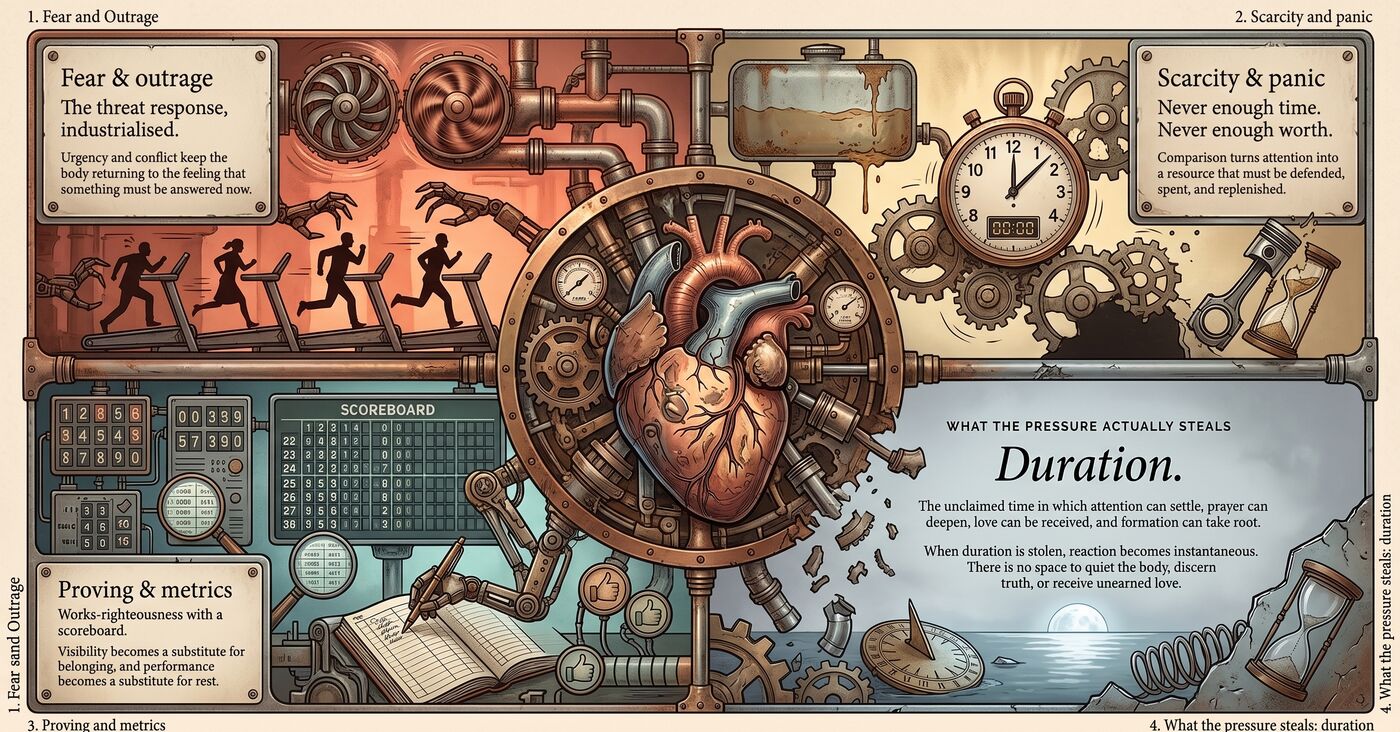
WHAT THIS PRESSURE ACTUALLY STEALS
Under the constant pressure to react, prove, and consume, the unclaimed space between arrival and consent disappears.
That pause is the interval: enough duration for a feeling to be named, a claim tested, a Word received, and love freely chosen; because love requires freedom, uncoerced consent, and space to receive. When the interval is stolen, what replaces love isn’t just a rushed decision—it is compulsion, automated reflex, and survival.
“Prove all things; hold fast that which is good.”1 Thessalonians 5:21, KJV · held with Philippians 4:8
Listen to this teaching.
The Architecture of the Stolen Interval — A narrated white paper
THE PULSE OF SECOND HUMANITY · SEVEN SCRIPTURAL CLAIMS
Second Humanity is not humanity upgraded. It names human life received from another Source, gathered in Christ, and returned to the world as love.
What God gives as grace cannot be manufactured as achievement.
Genesis 2:7 · Romans 4:4–5We do not climb into divine life. In Christ, God crosses the distance toward us.
John 1:14 · Philippians 2:5–8Trust, desire, thought, intention, and allegiance meet at the root Scripture tells us to guard.
Proverbs 4:23 · Luke 6:45The gospel does not upgrade the old architecture or correct your reactions. It transplants the root: a new birth, life in the Spirit, and participation in the divine nature.
John 3:3–8 · Romans 8:1–6What is hidden may govern. What is brought before God can be discerned without becoming a verdict on the person.
Psalm 139:23–24 · John 3:20–21He does not teach the weary to carry self-sourcing more efficiently. He gives them his own life to learn.
Matthew 11:28–30 · Hebrews 4:9–11Grace does not leave us as isolated interiors. Love received becomes embodied among people and returns to the neighbour.
Matthew 22:37–40 · Ephesians 2:14–16“Come unto me, all ye that labour and are heavy laden, and I will give you rest.”Matthew 11:28, KJV
The destination is not an optimized self or a calm interior. The destination is Christ. Reclaiming the interval reopens the quiet ground where his invitation can actually be heard.
Life is received from the Father, embodied among a people, and returned to the table, the marketplace, the neighbour, and the street.
Follow the whole movement in The Premise →THE COUNTER-FORMATION · AN ARCHITECTURE OF PEACE
A single nervous system cannot resist automated extraction through willpower alone. It requires another home: a furnished space, an unhurried cadence, and a community rooted in love.
A teaching House. A protected room. An outward life.
THE HOUSE
The public threshold. The books, the theology, the root words, and the foundational premises. Truth uncovered before it is commodified.
See how the House works →THE UPPER ROOM
The furnished interval. A protected digital sanctuary for prayer, silence, and slow conversation—engineered deliberately without algorithms, streaks, notifications, or exposure metrics.
Enter the Upper Room →THE WALK
The outward life. The fruit of formation is not time retained on an app; it is love quietly restored to the dinner table, the work bench, the neighbor, and the street.
See the outward movement →The website explains the architecture. The Upper Room enacts it. The Walk returns it to the world.
THE THRESHOLD OF PREPARATION · LUKE 22:9–12
“Where wilt thou that we prepare?” Before the Cross, Jesus did not call his disciples into the noise of the square to debate the empire. He withdrew with them to a furnished upper room. Second Humanity is not an escape from the street, but a quiet interval from which a person may return to it whole.
No streaks · No soul scores · No exposure economy · Your words remain yours
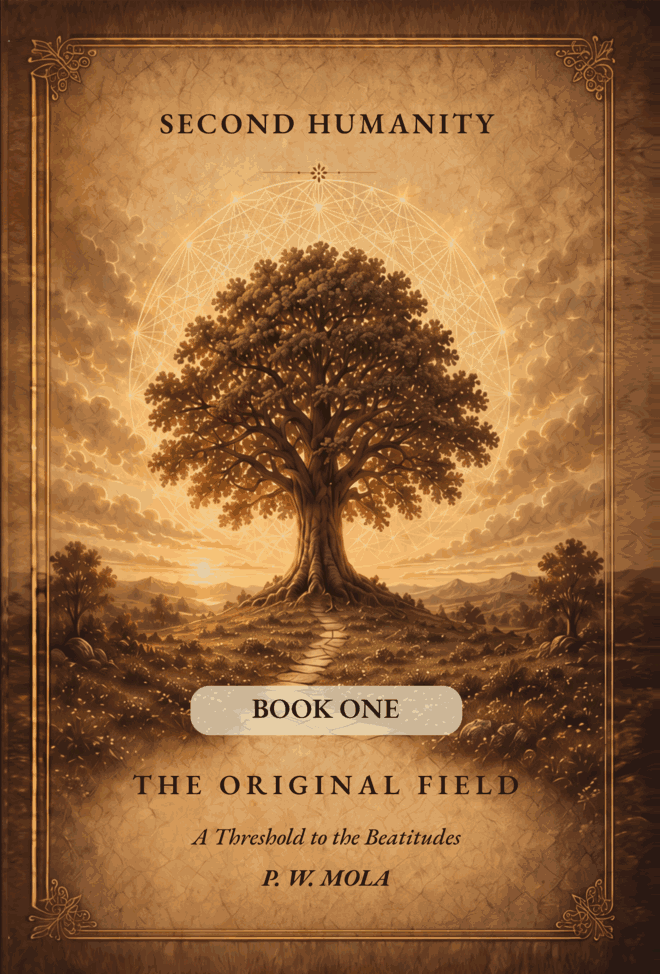
THE FOUNDATIONAL TEXT · BOOK ONE OF THE THRESHOLD
Before we can resist what is forming around us, we must recover what formed us in the beginning.
To understand what you are, you must first remember why you are. The Original Field is the written foundation of the House—an excavation of original root words beneath centuries of inherited distortion. It reclaims the purpose of creation, the sacred gift of human freedom, and the architecture of the Father’s uncoerced love beneath the Law and the Cross.
Movement One is open now inside the House, and Book One’s print edition was published in September 2026.
The Threshold · Book One of Three · P.W. Mola. The complete print edition of Book One is available now.
Listen to this teaching.
The Original Field — The inaugural reading
PLAIN ANSWERS
It is a quiet formation house for recovering a life governed by the Father’s love rather than fear, scarcity, and survival. Through the direct teachings of Jesus, unhurried personal reflection, and deliberate communal practices, it provides a sanctuary from modern digital exhaustion—helping you quiet the body under expectation, re-root the heart, and return to ordinary life with genuine peace.
Because whatever repeatedly holds your attention eventually commands your heart. Attention is not worship, but what you continually look at trains your fears, fuels your comparisons, and dictates your reflexes. Reclaiming the interval between arrival and consent allows you to test what is entering before it becomes your inner life.
They are the three movements of this counter-formation. The House: the public teaching, books, root words, and foundational premises. The Upper Room: the private, protected application where you pause, pray, read, and converse slowly—built deliberately without streaks, algorithms, or exposure metrics. The Walk: the outward life. The true measure of formation is never how long you stay on a screen, but the love, mercy, and truth you quietly return to your family, workplace, and street.
No. Second Humanity does not track your habits, score your soul, or promise self-mastery. It is not an upgrade to your performance. It is an unhurried, orthodox Christian path of surrender—stepping off the treadmill of self-sourcing to receive your life from the Father.
Yes, but with strict theological and pastoral boundaries. The Keeper is an AI companion grounded exclusively in Scripture and the historical foundations of the House. It is designed to listen, question, illuminate scripture, and help you prepare your thoughts. It is forbidden from acting as an authority, flattering you, diagnosing your mental health, or speaking as God. It is a mirror and an aid, never a substitute for the Holy Spirit or human fellowship.
Your words remain entirely yours. What you write inside the Upper Room is private by default and never used to feed public algorithms or advertising models. You choose what is kept private, what is backed up securely, and whether the Keeper interacts with your notes. Nothing enters a shared room unless you deliberately carry it there yourself.
No. Second Humanity is rooted squarely in historic, orthodox Christian faith. While modern spirituality often focuses on self-divinization, manifestation, or emptying the mind into an impersonal universe, Second Humanity is about communion with a personal Father through Jesus Christ. We do not look inward to discover our own divinity or manufacture peace through technique; we turn inward because the heart is where trust, fear, and allegiance dwell before God. It is contemplative, but deeply Christ-centered—restoring the biblical practices of stillness, prayer, and scripture meditation that have anchored the Church for two thousand years.
It is built for anyone carrying the weight of modern exhaustion. The spiritually fatigued: those tired of performative religion, moralistic striving, or transactional theology who desire to know God as an unhurried, living reality. The digitally weary: anyone feeling fragmented by algorithmic feeds, manufactured outrage, and chronic reaction who wants their peace and attention back. The seeker and the wounded: those who have stepped back from church culture or institutional noise, but remain deeply drawn to the person, words, and life of Jesus. You do not need a background in theology or an existing prayer habit to enter—only a hunger to lay down the burden of being your own source.
Yes. The House, entry into the Upper Room, and the core practices are freely open to anyone seeking rest. We reject paywalls around basic spiritual formation. Sustaining the House, publishing print editions of the books, and supporting the infrastructure are offered as voluntary stewardships for those who find life here and want to help keep the door open for others.
The Monthly Transmission
Receive the Monthly Transmission
Codex excerpts, formation practices, audio, and invitations — once a month, no more.
Occasional transmissions only. Unsubscribe at any time.